1009 | From Threads of Light to Math 2.0
Show notes
An episode touching hardware in the real world — worn LEDs and tired OLED monitors — software, AI, standards, energy, and a look at human-scale tech stories from social networks to education.
Timeline
- 00:00:04 Opening
- 00:00:43 Wearable light and failing pixels: tech meets the physical world
- 00:03:22 30 months of QD-OLED: burn-in is measurable
- 00:07:01 The .lan domain fight
- 00:09:51 Demoscene in the browser
- 00:11:58 OpenAI's math manuscripts: retractions and formalization
- 00:14:49 Math 2.0: beyond solving problems
- 00:16:45 Learn to write code even with AI
- 00:19:48 Whistle: tiny local speech recognition
- 00:21:17 Theranos.world: reliving a fraud from court documents
- 00:22:48 Orkut's founder returns with a community-first social pitch
- 00:24:31 Small talk as social glue
- 00:26:17 ADHD and the circadian clock
- 00:28:31 Batteries beat gas peakers in 43 markets
- 00:30:17 US restricts Microsoft and others in labor certification program
- 00:31:48 Ten years of funding education in Tanzania
- 00:33:32 Closing
Related links
- Show HN: Making a flexible "neon" t-shirt with LED filaments
- OLED burn-in test: 30-month update
- New gTLD Application for .lan
- Classic PC demoscene productions running natively in the browser
- OpenAI withdraws three mathematical results
- OpenAI Withdraws 3 Math Papers
- “Math 2.0” will need to value mathematical progress more holistically
- Yes, and
- I gave Opus 5.5 one prompt and six hours to visualize Invisible Cities
- Whistle: Speech to Text in 16.9 MB
- Theranos.world
- Orkut.com
- The value of not getting to the point (2015)
- ADHD as a circadian rhythm disorder: evidence and implications for chronotherapy (2025)
- 4-hour battery storage is cheaper to install than gas turbines all across globe
- Trump administration is suspending Microsoft from a green card program
- Tell HN: I've been paying for a rural Tanzanian's education for 10 years
This episode is produced by Bri. Bri uses advanced AI technology to turn the feeds you care about into podcasts made for listening. Contact us at hi@bri.so.
Transcript
Mia: Welcome back to the show, everybody. I'm Mia.
Milo: And I'm Milo. It's good to be here. We've got a really varied stack of stories today, and honestly the thing that ties them together is that thread of technology brushing up against the real world — actual fabric you can sew through, actual pixels that wear out, actual DNS servers in people's homes, actual students writing code, actual grids buying batteries.
Mia: Yeah, that's the throughline. It's software meeting hardware, and hardware meeting people. And we're going to start right at that intersection, with a hobbyist project that's genuinely delightful.
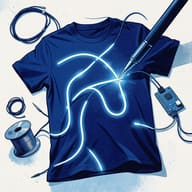
Milo: So the story is this: a person going by scottbez1 sewed flexible LED filaments directly onto a T-shirt. Not glued, not taped — stitched. And the electronics driving it are refreshingly humble: an ESP32 microcontroller and a boost converter to get the voltage up to where the LEDs want it.
Mia: And the part that I think is the real craft here is the design constraint. Because flexible LED filament comes in fixed lengths — it's not something you can cut arbitrarily and re-splice without consequences — so instead of fighting that, this person designed the light paths on the shirt to fit the filament length. The artwork is shaped around the material.
Milo: Which is a lovely inversion, right? Usually you sketch a design and then go hunting for parts that match. Here the part is the starting point and the design bends to it. That's very much how a lot of good physical computing work happens — you let the material's constraints do some of the design for you.
Mia: And the broader takeaway people keep drawing from projects like this is that e-textiles are genuinely within hobbyist reach now. This isn't a lab with conductive yarn weaving machines. It's an ESP32, a boost converter, a needle and thread, and patience. The barrier to entry is basically "can you sew a straight-ish line and write some firmware."
Milo: Right, and that's worth sitting with for a second. A decade ago, putting addressable light on clothing meant rigid LED strips that cracked at every bend, or expensive bespoke flexible PCBs. Flexible filament changes the failure mode entirely — it moves with the fabric. The remaining problems are the classic wearable ones: power, strain relief where wires meet the board, washing.
Milo: The source doesn't get into washability, so I'll flag that as an open question rather than pretend we know how this shirt survives the laundry.
Mia: Fair. And I'd add that the ESP32 choice matters too — it's cheap, it's wireless-capable, it's got enough horsepower for animation patterns. It's become the default brain for this kind of thing, which means tutorials and community knowledge are everywhere. When the tooling is this commoditized, the differentiator is the design thinking, exactly like the filament-length-aware paths here.
Milo: Okay, so that's the uplifting end of tech-meets-physical-world. Let's go to the sobering end. Because if LEDs on fabric show hardware improving, our next story is about a display technology showing its age — publicly, measurably, on the internet.
Mia: TechSpot ran a QD-OLED monitor for thirty months. That's eight thousand hours of productivity use — so think desktop work, text, spreadsheets, browsers, the stuff most of us actually do all day, not gaming or movies.
Milo: And the finding, after all that time: measurable burn-in, and reduced brightness. That's it in a sentence, but the sentence carries a lot of weight, because burn-in has been the central anxiety around OLED monitors since they arrived on desks.
Mia: Let's unpack why this matters so much. OLED's selling points for a monitor are phenomenal — per-pixel light means true blacks, near-instant response, gorgeous contrast. The trade-off has always been that organic materials degrade with use, and if some pixels are lit more than others — like your taskbar, or a static IDE layout — they age faster, and you get a ghost image burned in.
Milo: And the key word in this test's result is "measurable." It's not "the monitor is destroyed." It's that with instruments, after eight thousand hours of productivity-type content, you can detect burn-in and a drop in brightness. Whether that's visible to a given person at normal viewing distance is the question everyone has their own answer to.
Mia: Right, and that's exactly where the disagreement lives. One camp says: this confirms what we feared, that OLED as a primary desktop monitor is a compromise, because productivity use is precisely the worst case — static UI elements for hours on end. If you're choosing a monitor you'll stare at for eight hours a day for years, measurable degradation at thirty months is a real data point against it.
Milo: The other camp pushes back with usage-pattern arguments: eight thousand hours of mixed productivity is not everyone's pattern. If you watch a lot of video, game with varied scenes, or use dark themes and hide your taskbar, your pixel wear is much more uniform. And monitor makers ship burn-in mitigations — pixel shift, logo dimming, refresh cycles — which these tests may or may not have had running. We don't have that detail from the coverage, so it's a genuine unknown.
Mia: And there's a deeper unresolved question: how do these results generalize? Thirty months of one person's or one test rig's usage is one data point. Does a QD-OLED panel from a different generation behave the same? Does a WOLED panel? Does brightness recovery from those built-in compensation cycles claw anything back over time? Nobody can answer that from a single long-term test.
Milo: But here's what I take away as the fair summary: burn-in on QD-OLED is real, it's measurable within roughly two and a half years of heavy desktop use, and anyone buying one for productivity should walk in with eyes open — warranties, mitigation settings, and maybe a mental budget for panel life. It's not a dealbreaker for everyone; it is a real cost.
Mia: Which is a nice segue, actually, because both of these stories are about things wearing out or fitting into physical constraints. Our next one is about names wearing out conflicts into the internet's plumbing. There's an ICANN application for a brand-new generic top-level domain: dot-lan.
Milo: And if you've set up a home router in the last decade, dot-lan probably rings a bell, because OpenWRT — the open source router firmware — uses dot-lan as its default suffix for local hostnames. Your router at home might literally be reachable at something dot-lan right now.
Mia: So the conflict is obvious: a grassroots convention that millions of home networks already use is now on a path to becoming an official, delegated, ICANN-controlled gTLD. If dot-lan gets delegated, what happens to every router and every script that assumed dot-lan meant "my local network"?
Milo: The critics' answer points at RFC 8375, which already standardized a home-network domain: home.arpa. That's the "correct," blessed answer — arpa domains are special-use, they're not for sale, they can't be delegated to someone else, and they were created precisely so home networks would have a safe namespace that can never collide with the global DNS.
Mia: So you have three positions essentially: the applicant, who presumably sees value in a real, registrable dot-lan; the OpenWRT and home-lab crowd, who have years of muscle memory and configs built on dot-lan and now face potential ambiguity — does dot-lan resolve locally, or does it leak out to the public DNS and resolve to someone else's server? That's not just an aesthetic worry, it's a security worry.
Mia: If your laptop sometimes resolves dot-lan names globally, you can get lookalike responses and confusion about what you're actually talking to.
Milo: Exactly. DNS split-horizon stuff is subtle. And the unresolved question is what ICANN does with an application for a suffix that's in de facto widespread private use. There's precedent for special-use reservations, but whether that machinery gets applied here — or whether dot-lan goes to auction like any commercial string — is genuinely open. Meanwhile the migration path the critics favor is simple: switch your home network to home.arpa, per the RFC, and the problem slowly dissolves.
Milo: Whether millions of routers and tutorials actually do that is another matter.
Mia: From naming standards, let's go to preserving software standards of a very different kind — the demoscene. Classic PC demos, including the legendary Second Reality, now run in a browser.
Milo: For listeners who didn't live through this: demos are programs — often tiny — that push a machine's audiovisual limits in real time, no pre-rendering, and Second Reality is one of the all-time classics from the early nineties PC scene. These things were written for specific hardware, specific DOS versions, specific timings. Emulating them faithfully is notoriously finicky.
Mia: And the technical approach here is a stack, not a single trick: x86 emulation, C transpilation, and WebAssembly. So some parts run emulated instruction by instruction, some code gets transpiled from C and compiled ahead of time into WebAssembly, and the browser becomes the host machine. Each layer is a different trade-off between fidelity and speed.
Milo: And this matters beyond nostalgia. These demos are cultural artifacts — they're the folk art of the programmer generation that grew up writing assembly because that's all there was. If they only run on carefully maintained retro hardware or fragile DOS configurations, they rot. A browser is the most durable runtime humanity has ever built; a machine from 2050 will presumably still open a web page.
Mia: There's also a subtle preservation insight in the technique: perfect emulation isn't always the right preservation strategy. Sometimes the honest approach is a hybrid — emulate what's hard, transpile what's portable — and accept that you're doing restoration, like a film archive does. Purists will debate whether a partially transpiled demo is "the real thing," and that debate isn't settled. But a demo you can actually watch beats a perfect one you can't.
Milo: Okay. From preserving the past, we jump to auditing the present — and this next story is one where rigor really matters. OpenAI had to retract three mathematical manuscripts.
Mia: Let me set this up carefully, because the details here are what make it interesting. These are math papers produced with AI assistance — one of them in the Kuga–Satake, K3 surface area, which is deep, serious number theory territory. The retractions were due to sign errors.
Milo: Sign errors. In mathematics that's almost poignant — the whole edifice is supposed to be checked symbol by symbol, and a flipped sign can take a correct-looking argument to a false conclusion. And these weren't typos in a blog post; these were manuscripts positioned as research contributions.
Mia: Now, the fuller picture from the project's own history: three retractions, fourteen manuscripts revised, six new Lean formalizations, and — this is the big number — 300 of 719 results formalized, which is about 42 percent.
Milo: So there are two ways to read that and I think both are live in the discussion. The critical reading: nearly half the claimed results weren't machine-verified, retractions happened, therefore AI math output must be treated as untrusted drafts until proven otherwise. A sign error in a published manuscript is exactly the failure mode formal verification exists to catch.
Mia: The more sympathetic reading: the process worked. Errors were found, papers were revised rather than quietly forgotten, and a substantial fraction of results — over 300 — have been formalized in Lean, meaning a proof assistant has checked them down to axioms. That's a higher standard of verification than most human mathematics papers ever undergo. Most published human papers are checked by a couple of peer reviewers, not by a proof checker.
Milo: That's the genuine tension, and I don't think we should pretend it resolves. The retraction shows the informal output can't be taken at face value; the formalization shows a pipeline exists that can make it trustworthy. The unresolved question is whether the formalized 42 percent is representative — are the hardest, most interesting results the ones getting formalized, or the easy ones? Formalizing 300 results means little if the 419 unformalized ones contain the deep claims.
Milo: And the Kuga–Satake retraction specifically stings because that's exactly the kind of result where informal verification is hardest.
Mia: And that leads naturally to the next story, because one of the people watching this space most closely is Terence Tao, and he has a framing for where this should all go: he calls it Math 2.0.
Milo: Tao's argument — and this is the part worth dwelling on — is that "Math 2.0" should value more than problem-solving. That's a pointed statement, because if you asked most people what AI's role in math is, they'd say "solves problems." Tao says that's too narrow. The ecosystem of mathematics also includes exposition — writing things so other humans understand them — and community, and opening new research directions.
Mia: Which connects directly to what we just discussed. A retracted manuscript is a failure of exposition and rigor in the traditional sense — a paper that looked right but wasn't. Lean formalization addresses the rigor half, but it does nothing for the exposition half. Nobody reads Lean proofs to get intuition.
Mia: So if the future is AI-generated candidate proofs plus formal verification, the human contributions Tao is naming — explaining, teaching, building community, pointing research at fruitful new questions — become more valuable, not less.
Milo: There's also a quiet implication for how we evaluate these AI math projects. If the metric is "number of results solved," a project can look great while producing untrustworthy papers. If the metric includes exposition quality, formalization coverage, and whether the work opens new directions, the picture gets more honest. Whether the field actually adopts those broader metrics is an open question — incentives are sticky.
Mia: And that theme — don't outsource the part that builds your understanding — is precisely the heart of our next story. Carson Gross, who many listeners will know as the person behind htmx, has advice for students: write code yourself, even in the AI era.
Milo: His reasoning is about learning to read and understand code. The argument goes something like this: the hard part of software engineering isn't typing; it's reading — understanding a codebase, understanding why something is the way it is, spotting what's wrong. If AI writes everything and you only ever skim the output, you never develop that muscle. You become fluent at prompting and illiterate at the thing you're producing.
Mia: And his prescription isn't abstinence — it's explicit: use AI as a tutor. So the AI explains, critiques, answers questions, but the student does the writing. That's a very different relationship than "generate and paste," and it maps to how good human mentorship works: a mentor doesn't write your problem sets for you.
Milo: Now, the counterpoint that always comes up: industry is moving fast toward AI-generated code, so isn't teaching students to hand-write code like teaching latin? And Gross's implicit answer — and honestly the experience of anyone who has debugged AI-generated code — is that reviewing and fixing generated code requires exactly the understanding that hand-writing builds. You can't supervise what you can't read.
Mia: There's a nice concrete illustration of what AI can do when pointed well, though — and it doubles as a data point in this debate. Someone had Opus 5.5 visualize Italo Calvino's "Invisible Cities" in Three.js, the browser 3D library. One and a half hours of work, about 74 dollars in API costs, and six parallel subagents doing the work.
Milo: And look, that's genuinely impressive as a demonstration — a literary, atmospheric visualization, built in an afternoon, for less than a nice dinner. It's the strongman argument for the AI-coding side: look what one person with good taste and good prompting can now make.
Mia: But notice what made it work: the person had a clear vision — Calvino's book, a specific aesthetic — and orchestrated the agents. The taste and the direction were human. Nobody would claim the subagents understood Calvino. So both stories actually agree on the division of labor: AI is a phenomenal amplifier for people who know what they want and understand the medium. The disagreement is only about what happens to people who never build the understanding in the first place.
Milo: From writing code to understanding speech — in the literal, model-weight sense. There's a new speech recognition model called Whistle, and the numbers are the story: 16.9 megabytes.
Mia: Sixteen point nine megabytes. For context, that's smaller than a single photo from a modern phone. And it covers seven languages, runs locally on a CPU — no GPU, no cloud — and the first token comes in 11 milliseconds.
Milo: That latency number is the one that changes product thinking. Eleven milliseconds is faster than you can perceive. It means speech recognition that responds instantly, everywhere — on cheap hardware, offline, in a hearing aid or a car or an embedded device — without sending your voice to anyone's server.
Mia: And the privacy angle writes itself: if the model runs locally, your voice never leaves the device. That removes the whole consent-and-surveillance conversation from voice interfaces. The open question is accuracy versus the big cloud models — a 17-megabyte model covering seven languages is making real trade-offs somewhere, and per-language performance details matter a lot. But as a proof of direction, "good enough speech recognition as a tiny local artifact" is a big deal.
Milo: Which brings us to a very different kind of interactive artifact — one built not to recognize voices but to make you sit inside one. It's called Theranos.world, and it's an interactive simulation of Elizabeth Holmes's desk.
Mia: You sit at her desk, and the texts, the emails, the messages you read as you click through — all of it comes from court records. That's the crucial design decision. This isn't a dramatization with invented dialogue. Every piece of text you encounter is sourced from the actual legal proceedings of the Theranos fraud case.
Milo: And that's what makes it a new form for exploring a corporate fraud. Reading a fraud case as a verdict or a news summary gives you conclusions. Sitting at the desk, reading the messages in sequence, gives you the texture — the day-to-day rhythm of decisions and pressures. The simulation form forces you to inhabit the environment in which those decisions felt, presumably, normal to the people making them.
Mia: There's an obvious resonance with our Carson Gross discussion, actually — interactive media as a way of building understanding that a summary doesn't. You remember what you did. Whether this format catches on for other cases, and whether it risks creating sympathy for its subject by humanizing her, are fair open questions. But as an experiment in documentary form, it's striking.
Milo: From one founder's desk to another founder's comeback attempt. Orkut — yes, that Orkut, the social network that Google shut down years ago — its creator, Büyükkökten, has launched a campaign for a new social network built around being human and community-oriented.
Mia: The relevant history here: Orkut was, at its peak, dominant in Brazil. Not popular — dominant. It's one of the clearest cases of a social network becoming the infrastructure of a country's online social life and then losing that position. So the founder returning to the space carries real weight, both as credibility and as a question mark.
Milo: The pitch itself — human, community-oriented — is the interesting part, because every generation of social networks says some version of it. The hard question the story raises is whether a nostalgia-driven, values-forward platform can actually succeed against network effects. People don't join communities; they join people. The open question is whether enough people move at once, and whether the founder's history in Brazil gives him a wedge to restart there first.
Mia: And there's a genuine unsolved problem underneath: everyone agrees the big platforms feel bad in specific ways, and every challenger promises a human alternative, and the graveyard of challengers is enormous. Whether this one is different will come down to execution, not intention — which, honestly, is what everyone said about the last five.
Milo: Speaking of intentions versus execution in human interaction — the next story is small, old, and quietly profound. A piece by Ken Arneson from 2015, resurfacing, making an argument about small talk.
Mia: The claim: small talk before the actual topic of a conversation isn't wasted time — it builds trust and lowers vulnerability. When you're about to say something that could make you feel exposed, having warmed up with trivial chatter makes the real conversation feel safer.
Milo: And once you hear it, you see it everywhere. The five minutes about the weather before the difficult family conversation. The banter before the standup meeting's hard questions. Even in podcasting — we do it — the first minutes of a show are social calibration, not content.
Mia: There's a sharp modern edge to this, too: we keep trying to optimize conversation. Skip the pleasantries, get to the point, "no small talk please." And Arneson's argument suggests that's optimizing away the load-bearing part. The small talk is the trust-building mechanism; remove it and the substantive conversation carries more risk, so people share less.
Milo: The connection to the AI theme from earlier is almost too neat — if more of our conversations are with models that never need trust built, do we lose the practice? And do conversation interfaces that skip pleasantries get worse answers from humans, because humans arrive guarded? I don't think anyone's answered that rigorously, but it's the kind of question this little 2015 essay provokes.
Mia: From social calibration to biological clocks — our next story is a review article arguing something that would have sounded odd a decade ago: that ADHD may be, at least in part, a disorder of the circadian rhythm.
Milo: To be precise about what the source claims: this is a review — a synthesis of existing research, not a new trial — discussing ADHD as a disruption of circadian rhythm, and discussing chronotherapy as an approach. Chronotherapy meaning interventions on light exposure and sleep timing, trying to retrain the body clock rather than only treating attention directly.
Mia: The plausibility hooks are real: sleep problems are extremely common in ADHD, evening circadian phase delay shows up in studies of people with ADHD, and stimulant medications affect sleep, which can feed a vicious cycle. If some of the attention symptoms are downstream of a mistimed body clock, then light timing, sleep scheduling, and related interventions could help some people — potentially as a complement to medication, or in some cases an alternative.
Milo: But let's be careful about the uncertainty, because this is a review, not a randomized trial program. The causal question — is the circadian disruption a cause of ADHD symptoms, a consequence, or a shared symptom of something else — is not settled. Reviews can correlate; they can't by themselves prove that fixing the clock fixes the attention. And ADHD is heterogeneous; it would be surprising if one mechanism explained everyone.
Mia: Still, if chronotherapy trials pan out even partially, the implications are attractive: light and sleep interventions are cheap, low-side-effect, and scalable in ways medication isn't. That's why people are watching this space. The honest summary is: a promising reframing with real mechanistic support, awaiting the interventional evidence that would make it clinical practice.
Milo: From the biology of attention to the economics of the grid — and this next one is about as concrete as economics gets. Wood Mackenzie looked at 4-hour battery storage versus open-cycle gas turbines — the "peaker" plants that fire up for a few hours a day when demand spikes — across 43 electricity markets.
Mia: And the finding: in all 43 markets, the batteries were cheaper. All of them. Not "in sunny places" or "in markets with high gas prices" — everywhere studied.
Milo: That's a landmark result because gas peakers have been the default answer to daily demand peaks for decades, and the argument for building more of them has been eroding for a while. If the cheapest option for the peaker role is now batteries everywhere, the economics of the transition tilt further than most people's mental models assume.
Mia: Now the caveats worth naming. Four-hour storage covers the daily peak-shaving role, but a gas turbine can run for many hours or days if fuel is available; batteries at four hours don't cover a multi-day wind drought or a polar vortex. So this result speaks to the peaker niche specifically, not to gas's entire role.
Mia: Whether 43 markets' worth of peaker projects actually get cancelled or converted in response is the real-world test — capital plans move slowly, and there are political dimensions to generation choices that pure cost doesn't settle.
Milo: But as a directional signal, it's about as strong as they come. Watch the procurement pipelines in the next couple of years; if the economics hold, the change should show up in what actually gets built.
Mia: From markets to policy with a human edge. US authorities have excluded Microsoft and other companies from the Permanent Labor Certification Program, citing alleged visa misuse.
Milo: Quick setup for listeners: permanent labor certification is a step in employment-based green card sponsorship — the employer certifies that it tried and failed to find US workers for the role. Being excluded from that program is a serious administrative consequence; it disrupts long-term immigration paths for employees at those companies.
Mia: The stated basis is alleged misuse of the visa system, and the word "alleged" is doing real work there — this is an enforcement action, the companies presumably contest it, and the legal details are still unfolding. What we know from the source is who is affected — Microsoft among others — and the stated justification.
Milo: The ripples are worth thinking through. For the companies, hiring and retention plans for foreign nationals get more complicated overnight. For the workers themselves, this lands on individuals' lives — people mid-process on permanent residency. And the unresolved questions are procedural: what exactly is the alleged misuse, what's the process for the companies to respond, and whether this is targeted enforcement or the leading edge of a broader posture.
Milo: We don't have those answers yet, and it would be wrong to guess.
Mia: And after that heavy one, let's end on the brightest note of the day. An original poster on the forum shared that they've spent ten years funding education in Tanzania.
Milo: Ten years. And the human outcome at the center of the post: a student named Anwarite has completed a university degree. And the project has grown into something formal — a registered 501(c)(3) nonprofit that's currently supporting five students.
Mia: I love this as a closing story for a few reasons. First, the timeframe. Ten years is longer than most startups, most grants, most attention cycles. Education philanthropy is full of pilots that run eighteen months and produce a report. This is one person's sustained commitment, measured in a person's actual completed degree.
Milo: And second, the trajectory — from individual help, to a named graduate, to an institutional structure supporting five more. That's how a lot of durable good actually happens: not through a big announcement, but through compounding, personal, unglamorous follow-through.
Mia: The honest open question, and the poster would probably say so themselves, is scale. Five students supported is a real, verifiable impact; whether the model grows to fifty or five hundred is a different challenge with different requirements. But as an answer to "can one person's consistent effort change specific lives?" — ten years, one degree, five students in the pipeline — it's a yes.
Milo: And that's the note to end on. Technology wearing in and wearing out, standards fought over, math formalized and retracted, code written by hand and by agents, batteries beating gas, and a decade of someone quietly funding educations.
Mia: Thanks for listening, everybody. We'll be back with more.
Milo: Take care.